I think I should have chosen a question from a topic I master
blackscales18 on
57?
lincompoopy on
The answer is always 42
squidyj on
127a1 – 21
Bootleg-Harold on
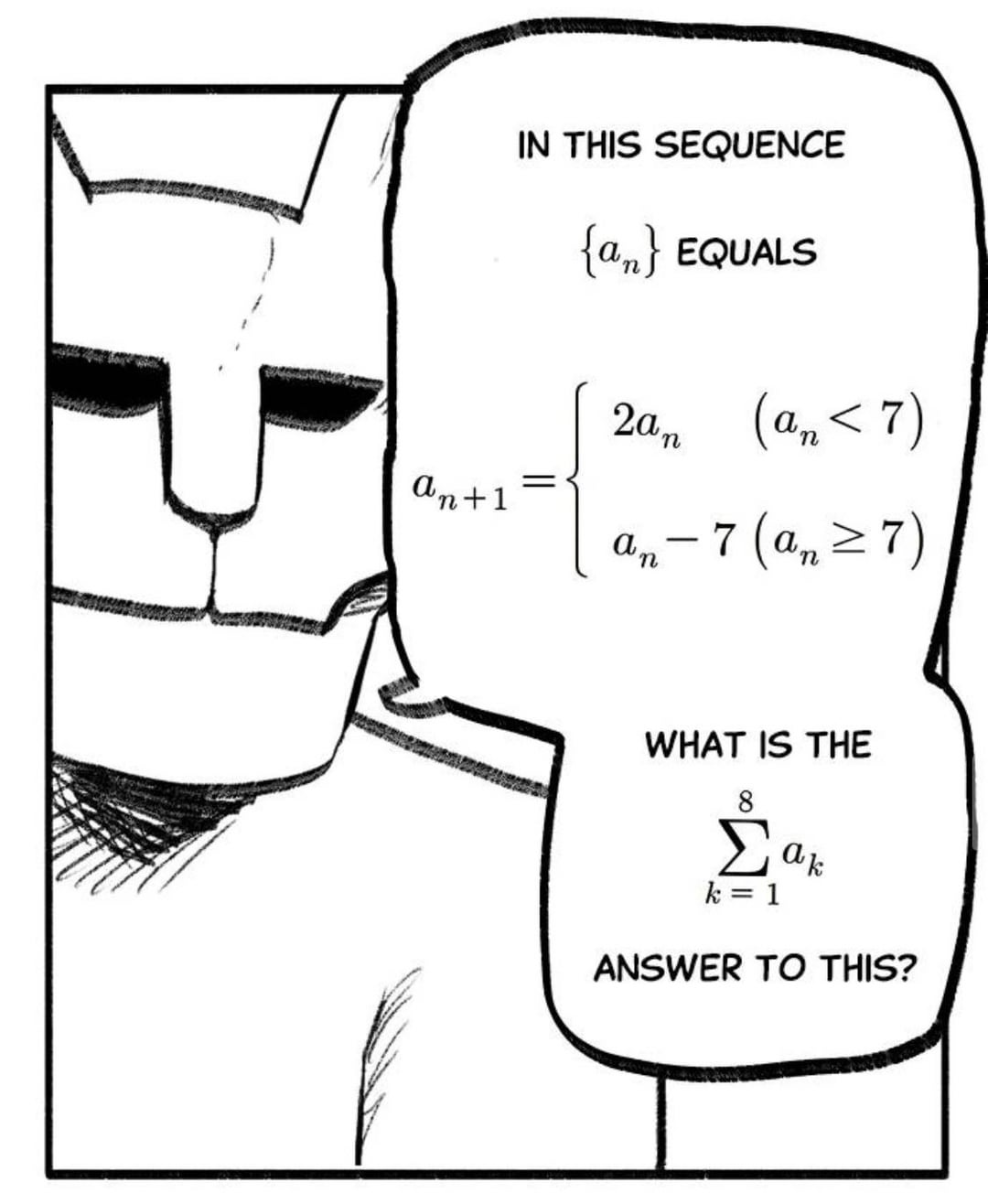
Since we don’t know what a_0 or a_1 is, it makes this impossible to solve with a single solution.
Assuming a_0 must be an integer (this is a big assumption but it seems and feels appropriate here), we can then split a_0 into 50 categories (for now I’ll split it into 8 and explain the rest at the end).
If a_0 is < 0, for example -5, then a_1 is 2 * a_0 = -10. So a_2 = – 20 etc… And we get that the summation is a_0 * (2^9 – 1) = 511 * a_0 (or 255 * a_1 if you started with a_1 instead of a_0 )
The reason for 2^9 – 1 is because of the sum of 2^i from 0 to k is 2^k+1 – 1.
Next is when a_0 = 0. a_1 = 2 * 0 = 0, and thus a_k = 0 for all k > 0, so the answer here for the summation will be 0 as well.
You will notice the pattern will loop on itself a couple of times and this would be extremely useful if n was much larger than 8. But adding up all those values (but not adding a_0) we get that the summation is = 15 + 15 = 30.
If a_0 = 2, you could use the pattern and show that the summation is also 30
If a_0 = 4, the summation again is = 30
I will ignore a_0 >= 7 for now and continue with 3, 5 and 6.
If a_0 = 3, the pattern is 6, 12, 5, 10, 3, 6, 12, 5, sum them up and we get 36 + 23 = 59
If a_0 = 5, the pattern is 10, 3, 6, 12, 5, 10, 3, 6. The sum is 36 + 19 = 55
If a_0 = 6, then the pattern is 12, 5, 10, 3, 6, 12, 5, 10 and summation is = 36 + 27 = 63.
Now if a_0 = 7, then a_1 = 0 or if a_0 = 8, then a_1 = 1, etc… this will apply up to and including a_0 = 13
Past a_0 = 13 (or past a_1 = 7) is where it becomes more tedious. This is because you keep subtracting 7 until you get a_n in the range [0, 7) but you can’t ignore the values that you subtract 7 from either.
I will skip to a_0 >= 56, after 56 you will only be subtracting 7 and can never reach the doubling part in the 8 steps.
Let c be a number that is equal to or greater than 56 (this makes it easier to show the solution) then if a_0 = c, then a_1 = c – 7, a_2 = c – 14, … , a_8 = c – 56.
Add those all up and you get that the summation is = 8c – (7 + 14 + 21 + … + 49 + 56)
If I had to give an answer based on all that, I would lean towards the answer being 30 as that occurs when a_1 = 1, 2 or 4, and I would assume the restrictions on a_1 to be 1, 2, 3, 4, 5 or 6

6 Comments
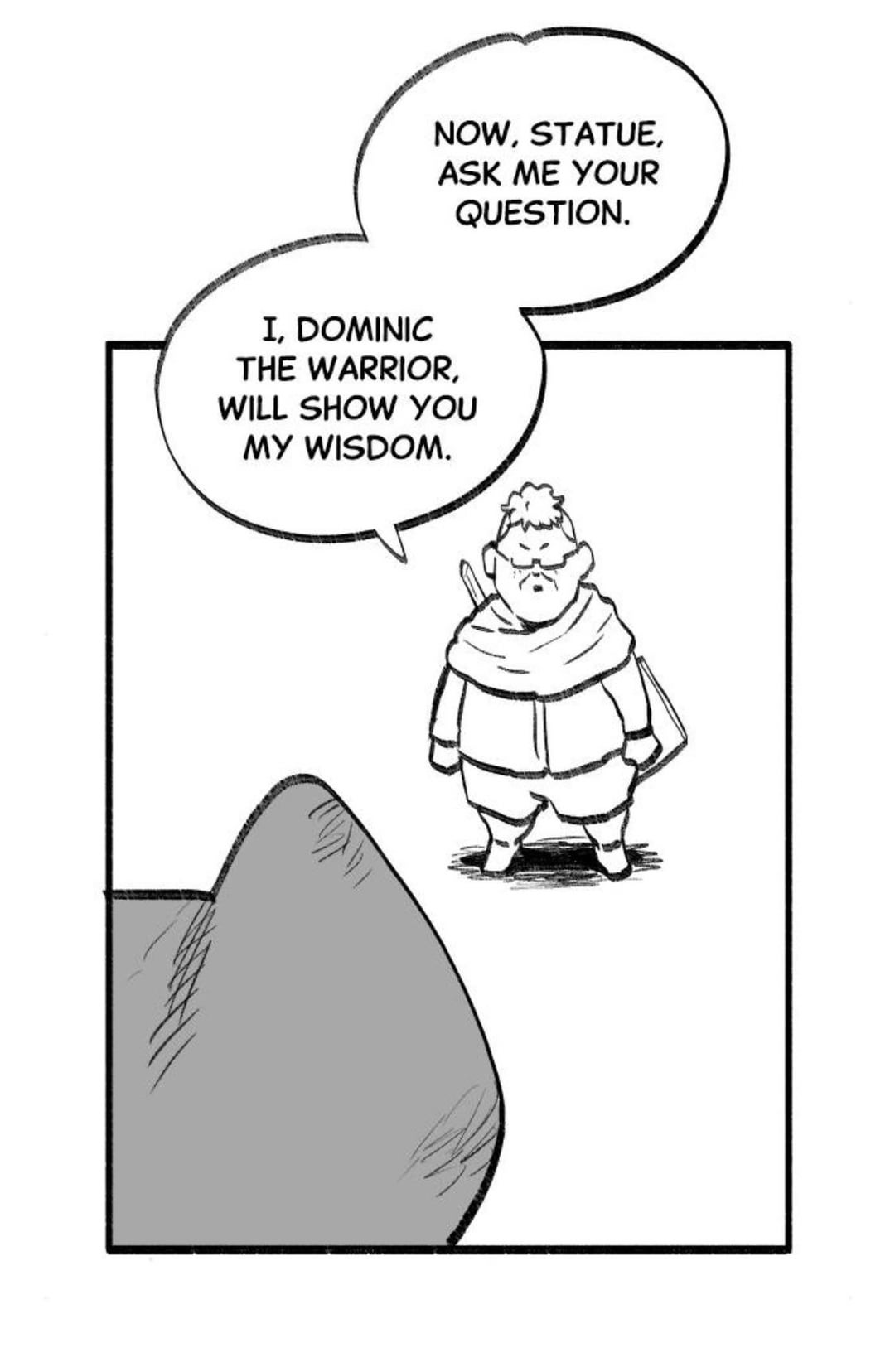
Sauce: teenage dragon (webtoon)
Irl because I’m Asian
I think I should have chosen a question from a topic I master
57?
The answer is always 42
127a1 – 21
Since we don’t know what a_0 or a_1 is, it makes this impossible to solve with a single solution.
Assuming a_0 must be an integer (this is a big assumption but it seems and feels appropriate here), we can then split a_0 into 50 categories (for now I’ll split it into 8 and explain the rest at the end).
If a_0 is < 0, for example -5, then a_1 is 2 * a_0 = -10. So a_2 = – 20 etc… And we get that the summation is a_0 * (2^9 – 1) = 511 * a_0 (or 255 * a_1 if you started with a_1 instead of a_0 )
The reason for 2^9 – 1 is because of the sum of 2^i from 0 to k is 2^k+1 – 1.
Next is when a_0 = 0. a_1 = 2 * 0 = 0, and thus a_k = 0 for all k > 0, so the answer here for the summation will be 0 as well.
When a_0 = 1, a_1 = 2, a_2 = 4, a_3 = 8, a_4 = 1, a_5 = 2, a_6 = 4, a_7 = 8 and a_8 = 1
You will notice the pattern will loop on itself a couple of times and this would be extremely useful if n was much larger than 8. But adding up all those values (but not adding a_0) we get that the summation is = 15 + 15 = 30.
If a_0 = 2, you could use the pattern and show that the summation is also 30
If a_0 = 4, the summation again is = 30
I will ignore a_0 >= 7 for now and continue with 3, 5 and 6.
If a_0 = 3, the pattern is 6, 12, 5, 10, 3, 6, 12, 5, sum them up and we get 36 + 23 = 59
If a_0 = 5, the pattern is 10, 3, 6, 12, 5, 10, 3, 6. The sum is 36 + 19 = 55
If a_0 = 6, then the pattern is 12, 5, 10, 3, 6, 12, 5, 10 and summation is = 36 + 27 = 63.
Now if a_0 = 7, then a_1 = 0 or if a_0 = 8, then a_1 = 1, etc… this will apply up to and including a_0 = 13
Past a_0 = 13 (or past a_1 = 7) is where it becomes more tedious. This is because you keep subtracting 7 until you get a_n in the range [0, 7) but you can’t ignore the values that you subtract 7 from either.
I will skip to a_0 >= 56, after 56 you will only be subtracting 7 and can never reach the doubling part in the 8 steps.
Let c be a number that is equal to or greater than 56 (this makes it easier to show the solution) then if a_0 = c, then a_1 = c – 7, a_2 = c – 14, … , a_8 = c – 56.
Add those all up and you get that the summation is = 8c – (7 + 14 + 21 + … + 49 + 56)
= 8c – 7(1 + 2 + … + 7 + 8) = 8c – 7(36) = 8c – 252
If I had to give an answer based on all that, I would lean towards the answer being 30 as that occurs when a_1 = 1, 2 or 4, and I would assume the restrictions on a_1 to be 1, 2, 3, 4, 5 or 6